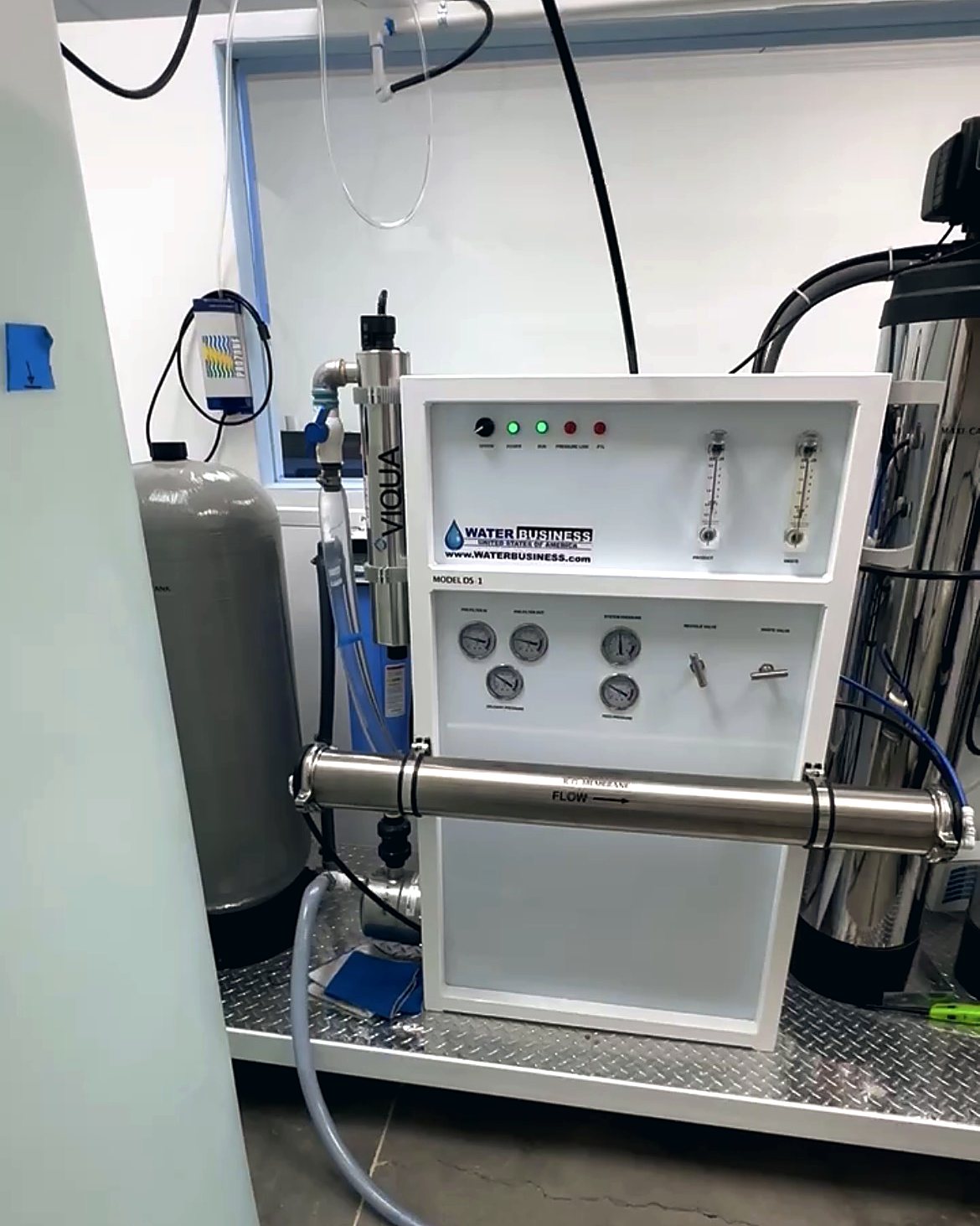
A salt free water softener does not soften water. The calcium and magnesium stay in your water. What a good salt free unit does is change how those minerals behave, so far less of them sticks to pipes, water heaters and fixtures as scale. In the Santa Clarita Valley, where automatic salt softeners are banned, that kind of system is the main legal way to protect a whole house from hard water.
This guide explains what a salt free system actually does, what it won't change, what the valley's rules allow, and how to pick between the legal options for your home.
What is the difference between a water softener and a salt free conditioner?
A traditional softener removes hardness. Water passes through resin beads that swap calcium and magnesium for sodium or potassium. When the beads are full, the unit flushes them with salty brine and sends that brine down the drain. That flush is why the valley banned them.
A salt free conditioner leaves the hardness in place. The most common type uses template assisted crystallization, often shortened to TAC. As water flows through the media, dissolved hardness minerals form tiny crystals that stay suspended in the water instead of clinging to surfaces. Nothing is added to the water, and nothing is flushed down the drain.
| Salt softener | Salt free conditioner (TAC) | |
|---|---|---|
| Removes calcium and magnesium | Yes | No |
| Reduces scale in pipes and heaters | Yes | Yes |
| Uses salt or potassium | Yes | No |
| Sends brine down the drain | Yes | No |
| Needs electricity | Usually | No |
| Legal in the Santa Clarita Valley | No (automatic units) | Yes |
So do salt free water softeners actually work?
They work at the job they are built for, which is cutting scale. They don't work at the job a softener does, which is removing hardness. Most of the arguments online come from mixing those two jobs up, and most of the pages making the argument are written by companies selling one type or the other.
If what bothers you is crusty buildup in the water heater, scale around faucets and showerheads, and appliances wearing out early, a salt free conditioner is aimed squarely at that. If you want water with the minerals taken out, a conditioner will not give you that. In the valley, the only legal whole house way to get softened water is a portable exchange tank service, covered below.
What changes after a salt free system goes in, and what doesn't
This is the part most guides skip, and it is where most disappointment comes from.
- Less scale where water heats up and sits. Water heaters, kettles, showerheads and faucet aerators build up much more slowly.
- Spots on glass and shower doors can still appear. When a drop of water dries, the minerals in it are left behind. Because the minerals are still in the water, the spots can still form, though they usually wipe off more easily.
- Soap behaves about the same. Lather and rinsing don't change the way they would with softened water.
- A hardness test strip will still read hard. The test measures minerals in the water, and those minerals are still there. A hard reading after install does not mean the system has failed.
- The taste of your tap water stays about the same. For drinking and cooking, a reverse osmosis system at the kitchen tap is the tool that changes what is in your glass.
Are water softeners banned in Santa Clarita?
Yes. Automatic, self regenerating softeners that use salt or potassium are prohibited across the Santa Clarita Valley, including Santa Clarita, Valencia, Saugus, Newhall, Canyon Country, Stevenson Ranch and Castaic. The brine they flush into the sewer raises chloride levels in the Santa Clara River. The rules are set by the LA County Sanitation Districts, which also run a removal program for old units on 1-877-CUT-SALT.
New in 2026: the ban now covers Valencia by FivePoint. The Newhall Ranch Sanitation District adopted the same ordinance on 1 September 2026, and it took effect on 1 October 2026, so homes and businesses in the Newhall Ranch service area, including Valencia by FivePoint, now follow the same rules as the rest of the valley, according to the Sanitation Districts. If you live there and still have a salt softener, or were about to buy one, it is worth checking your options now.
What are the legal hard water options for a Santa Clarita home?
| Option | What it does | Covers | Good fit if |
|---|---|---|---|
| Salt free conditioner (TAC) | Cuts scale, leaves minerals in | Whole house | You want to protect pipes, the water heater and fixtures with no salt and little upkeep |
| Portable exchange tank service | A company swaps a softening tank and recharges it off site, so no brine goes into your sewer | Whole house | You want softened water and don't mind a service schedule |
| Reverse osmosis at the kitchen tap | Filters out most dissolved minerals from drinking and cooking water | One tap | Your main concern is what you drink and cook with |
Many valley homes end up with two pieces: a salt free conditioner for the whole house and reverse osmosis at the kitchen sink. That is the setup in our Protector XC & Alka75, which pairs a salt free Turbo TAC system for the house with the WQA S-300 certified Alka75 drinking water system for the kitchen. We install and service it across the valley.
How to choose for your home
- Find your hardness number. Check the latest water quality report from SCV Water for the system that serves your address. Our post on whether Santa Clarita tap water is hard or soft explains how to read it.
- Decide what you are trying to fix. Scale on pipes and appliances points to a conditioner. Drinking water points to reverse osmosis at the tap. Many homes want both.
- Check what your area allows. Anywhere in the valley, rule out automatic salt and potassium softeners. That now includes Valencia by FivePoint in the Newhall Ranch area.
- Ask about upkeep before you buy. A TAC system needs its media replaced after some years of use, and a reverse osmosis system needs filter changes on a schedule. Ask for the schedule of the exact system before you buy. For the systems we install, we track it and remind you.
Our page on water softener options in Santa Clarita covers installation for each choice.
Common questions
Is a salt free water softener legal in Santa Clarita?
Yes. The valley's ban covers automatic softeners that regenerate with salt or potassium and send brine to the sewer. A salt free conditioner uses no salt and flushes no brine, so it is one of the legal whole house options. If you are replacing an old salt unit, the LA County Sanitation Districts' removal program is the place to start.
Why does my water still test hard after a salt free system was installed?
Because the minerals are still in the water. A salt free conditioner changes how calcium and magnesium behave so they don't stick as scale, but a test strip only measures how much of them is dissolved. A hard reading is normal. The way to judge the system is the scale on your water heater, faucets and showerheads over the following months.
Can I still use a portable exchange softener in the valley?
Exchange tank services are a legal way to get softened water, because the tank is recharged off site and no brine goes into your home's sewer line. You get the feel of softened water, with a delivery and swap schedule. Ask the service how often your household size needs a new tank.
Do I still need a filter if I have a salt free conditioner?
A conditioner is about scale, not about what is in your drinking water. If you want to change what comes out of the kitchen tap, reverse osmosis at the sink is the usual answer. That is why many valley homes pair the two.
Not sure which one fits your home?
Call or text Ricardo at (310) 569-2131 with your address and what is bothering you about your water, and we'll tell you which legal option fits. You can also find us at 23365 Lyons Avenue in Old Orchard Center.
Last updated 18 November 2026.